

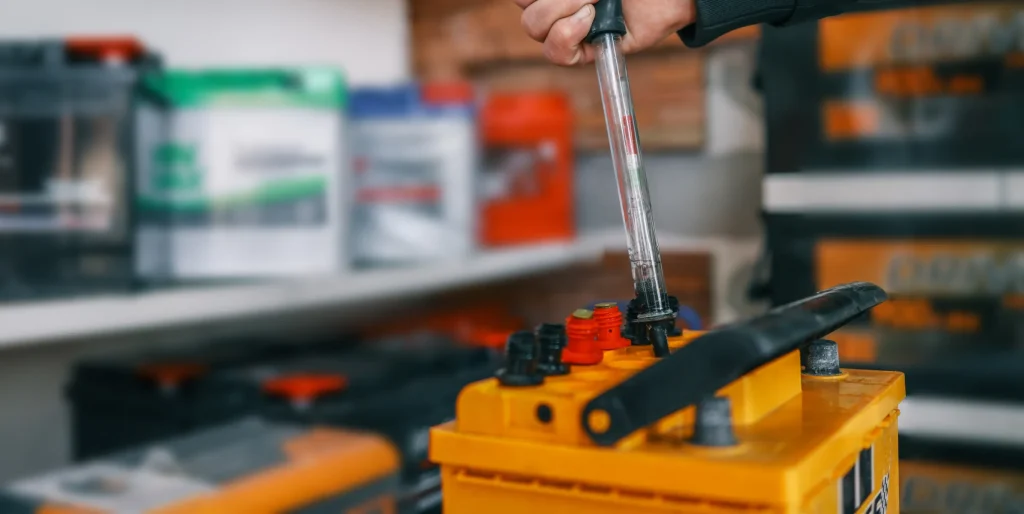

A refurbished hybrid battery should not be judged by appearance alone. The modules may look clean and display normal voltage while still having reduced capacity or inconsistent performance.
BattMech’s testing process is designed to evaluate the battery components, identify weak modules, create a closely matched pack, and verify that the finished product meets defined standards.
Here is a closer look at the steps involved.
Initial Battery Inspection
The process begins with a visual inspection of the battery pack and its components.
Technicians look for physical damage, corrosion, contamination, overheated connections, damaged wiring, broken connectors, and other signs of wear.
Battery cases, covers, brackets, sensors, and cooling components are also examined. A battery may have usable modules while still requiring replacement of damaged electrical or structural components.
Visible damage does not provide a complete diagnosis, but it helps identify safety concerns and areas requiring closer inspection.
Safe Battery Disassembly
Hybrid batteries contain high voltage and must be handled using appropriate safety procedures.
The battery is disconnected, opened, and disassembled in a controlled work area. Modules, bus bars, sensing wires, hardware, and other components are separated for inspection and testing.
Correct organization is important because the location and orientation of the modules must be documented throughout the process.
Technicians use proper personal protective equipment and tools intended for electrical work.
Module Voltage Evaluation
Each module is checked for voltage and compared with the others.
Voltage testing can reveal modules that are significantly discharged, unstable, or operating outside the expected range. It also provides information that can be used during the balancing process.
However, voltage alone does not determine whether a module is suitable for continued use. A module may show an acceptable resting voltage but have very limited capacity.
This is why capacity testing is a critical part of BattMech’s process.
Controlled Capacity Testing
Capacity testing measures how much energy a module can store and deliver.
The module is charged and discharged under controlled conditions using specialized testing equipment. The equipment records the amount of energy transferred and monitors the module’s electrical behavior.
Modules that lose voltage too quickly, cannot reach the required capacity, become unstable, or perform inconsistently are removed from consideration.
Charge-and-Discharge Cycling
Battery modules may be cycled more than once to evaluate their performance and improve the accuracy of the results.
Cycling can help reveal modules that behave normally during one test but become inconsistent during repeated use. It may also help stabilize modules that have been stored or partially discharged.
The goal is to understand how each module behaves under conditions that better represent the repeated energy movement inside a hybrid vehicle.
Matching and Balancing the Modules
After testing, qualifying modules are grouped according to their electrical performance.
The modules should have similar capacity and voltage behavior so that they charge and discharge together. A large difference between modules can cause one section to reach its operating limit before the others.
BattMech balances its battery packs to less than a 0.05-volt difference between modules at the time of testing.
Closely matched modules help create a more consistent battery pack and reduce the likelihood that one weak section will limit the complete system.
Inspecting Electrical Connections
The bus bars and nuts connect the battery modules and carry electrical current through the pack.
Old connection hardware may be corroded, contaminated, or worn. Corrosion can increase electrical resistance and interfere with voltage sensing.
BattMech batteries may include new nickel-plated bus bars and a new nut set. These components provide clean electrical contact and eliminate the need to reuse heavily aged connection hardware.
Sensing wires, connectors, and related electrical components are also inspected for damage.
Battery Reassembly
Module orientation, compression components, wiring, sensors, covers, and hardware must be installed correctly. Connections should be secured according to the proper procedure, and wiring is routed to prevent pinching or damage.
Supporting the Customer
Testing is only one part of the customer experience. Proper installation is also essential for dependable operation.
BattMech provides step-by-step video instructions for supported battery models. These resources help qualified installers identify the correct components, follow the proper sequence, and reassemble the vehicle correctly.
BattMech batteries also include a two-year warranty and do not require a core return.
Why the Testing Process Matters
A refurbished battery should be more than a temporary repair. Its modules should be evaluated for actual performance, matched with compatible modules, and assembled using dependable electrical connections.
By clearly defining how the batteries are tested and assembled, BattMech gives customers measurable information they can use when comparing replacement options.

Related Blogs
How a Hybrid Battery Affects Fuel Economy