

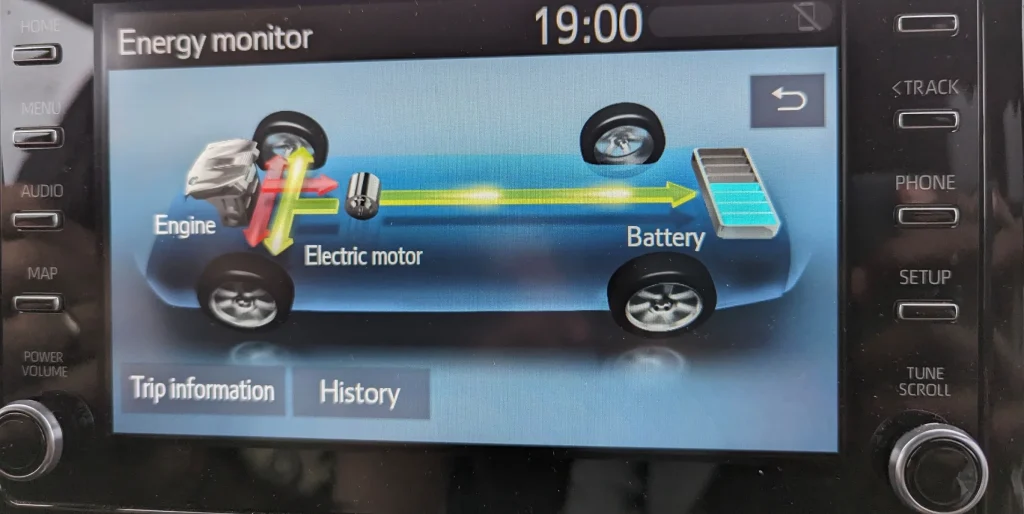

Hybrid vehicles use a combination of gasoline and electrical power to improve efficiency. The hybrid battery stores energy that would otherwise be lost and uses that energy to assist the vehicle during acceleration and low-speed driving.
When the battery is healthy, the gasoline engine does not need to provide all the vehicle’s power. When the battery becomes weak, the engine may run more often, resulting in lower fuel economy.
The Role of the Hybrid Battery
During braking and deceleration, the electric motor acts as a generator. It captures energy from the vehicle’s motion and converts it into electrical energy.
That recovered energy is stored in the hybrid battery. The vehicle later uses it to power the electric motor, assist the gasoline engine, and operate certain electrical systems.
This process is known as regenerative braking. It is one of the primary reasons hybrid vehicles can achieve better fuel economy than similar gasoline-only vehicles.
What Happens as the Battery Ages?
Rechargeable batteries gradually lose capacity. An older hybrid battery may not store as much recovered energy as it once did.
It may also deliver power for a shorter period before reaching its lower operating limit. The vehicle then starts the gasoline engine to provide the needed power and recharge the battery.
The hybrid system can often continue operating with a weakened battery, but it may not use electrical energy as effectively.
The Engine Runs More Frequently
A healthy battery can assist the engine during acceleration and may allow the gasoline engine to shut off during certain low-speed or stopped conditions.
When the battery is weak, the engine may start sooner, run longer, or remain on while the vehicle is stopped.
The additional engine operation consumes more fuel. Drivers may notice a gradual decrease in miles per gallon even before a hybrid warning light appears.
Rapid Charge-Level Changes
A battery with reduced capacity may appear to charge and discharge very quickly.
The dashboard display might show a high charge level after a short period of regenerative braking. A few moments later, the charge level may fall sharply during acceleration.
This happens because the battery’s usable energy range has become smaller. It reaches its upper and lower limits more quickly than a battery with stronger capacity.
Rapid changes in the charge display are often accompanied by increased engine operation and reduced fuel economy.
Module Imbalance Reduces Usable Energy
A hybrid battery is made up of many individual modules. The vehicle must protect the weakest section of the pack.
If one module reaches a low voltage before the others, the system may stop drawing energy from the entire battery. If one module reaches a high voltage early during charging, the system may reduce charging before the remaining modules are full.
This means the vehicle may be unable to use all the energy that the stronger modules could otherwise provide.
Closely matched modules allow the battery to operate over a more consistent range. BattMech balances its battery modules to less than a 0.05-volt difference and uses modules tested at greater than 5.0 amp-hours of capacity for its 2 year warranty batteries.
Heat Can Reduce Efficiency
Battery temperature also affects hybrid performance. When the battery becomes too warm, the vehicle may limit charging or electrical assistance to protect the system.
A clogged cooling fan or blocked air intake can contribute to higher battery temperatures. The cooling fan may become louder as it attempts to move more air through the pack.
If the vehicle limits battery operation because of heat, the gasoline engine may need to do more work, reducing fuel economy.
Keeping the cooling intake clear is an important part of hybrid battery maintenance.
Other Causes of Reduced Fuel Economy
A decrease in fuel economy does not always mean the hybrid battery is failing.
Cold weather, low tire pressure, worn tires, engine problems, dirty filters, poor-quality fuel, heavy cargo, roof racks, and changes in driving style can all affect mileage.
Before replacing the battery, the vehicle should be scanned for diagnostic codes and inspected for other maintenance issues.
Comparing fuel economy over several tanks of fuel is more useful than relying on one short trip or dashboard estimate.
Can Replacing the Battery Improve Mileage?
If reduced battery performance is causing the engine to run more frequently, replacing the battery may help restore normal hybrid operation and improve fuel economy.
The amount of improvement will depend on the condition of the engine, tires, brakes, and other vehicle systems. A replacement battery cannot correct unrelated mechanical problems.
After installation, the hybrid system may need time to adjust as the vehicle returns to normal driving patterns.
Choosing a Replacement Battery
When selecting a refurbished hybrid battery, look for measurable testing standards.
Ask whether the modules were capacity-tested, how closely they were voltage-matched, whether the complete pack was inspected, and what warranty is included.
BattMech provides tested and balanced refurbished hybrid batteries, and less than a 0.05-volt difference between modules. BattMech offers hybrid batteries greater than 5.0 amp-hours of module capacity, new nickel-plated bus bars, new nuts, video instructions, and two-year warranties.
A healthy hybrid battery supports more than vehicle acceleration. It plays a central role in how efficiently the complete hybrid system operates.


Related Blogs